Climate Resilience Overview
Ethiopia’s National Strategic Framework for Carbon-Neutral Development and Climate Adaptation.
1. Scientific & National Context
Climate change refers to the long-term alteration of temperature and typical weather patterns in a place. For Ethiopia, this is characterized by a 1°C increase in mean temperature since the 1960s and a 25% increase in rainfall variability. These shifts directly impact Ethiopia’s GDP, where climate-induced droughts can result in a 1% to 4% annual GDP loss.
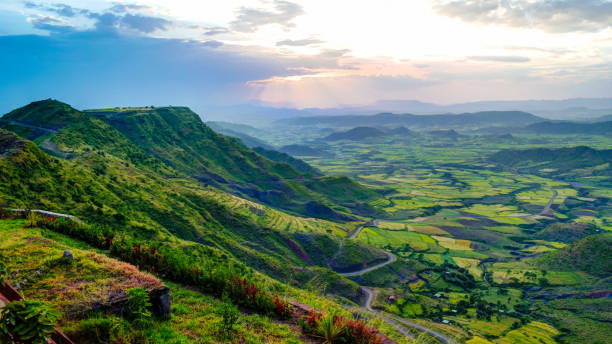
Landscape restoration in the Ethiopian Highlands.
Ethiopia's vulnerability is largely tied to its climate-dependent agriculture sector, which supports 80% of the population. Mitigation and adaptation are therefore not only environmental goals but core economic survival strategies.
2. Strategic Evolution (2011–2026)
Ethiopia launched the Climate Resilient Green Economy (CRGE) strategy, aiming for middle-income status by 2025 with no net increase in greenhouse gas (GHG) emissions.
A massive national mobilization began, planting over 40 billion seedlings to date, increasing forest cover from 15% to 23.6% by 2024.
Ethiopia became the first nation to ban internal combustion engine (ICE) vehicle imports, accelerating the shift to electric vehicles (EVs).
Official rollout of the 3rd Nationally Determined Contribution, targeting a 70.3% emission reduction by 2035.
3. Current Targets & Pledges
Under the NDC 3.0 (2025-2035) and the Long-Term Low Emission Development Strategy (LT-LEDS), Ethiopia has committed to:
| Focus Area | Target Metric | Target Year |
|---|---|---|
| GHG Mitigation | 70.3% reduction vs. BAU (Business As Usual) | 2035 |
| Forest Cover | Increase to 30.0% national coverage | 2030 |
| Renewable Energy | 16,058 MW total installed capacity | 2030 |
| Green Mobility | 500,000 Electric Vehicles on road | 2033 |
| Net-Zero Status | Full Carbon Neutrality | 2050 |
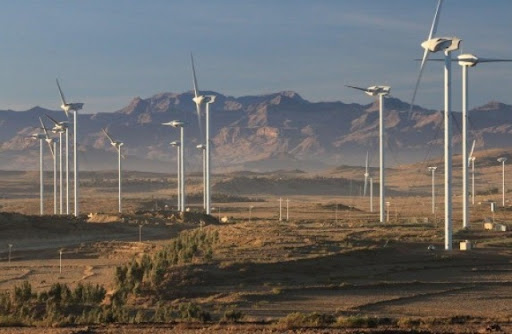
Renewable Energy Focus
Ethiopia generates 98% of its electricity from renewable sources (Hydropower, Wind, and Geothermal). Projects like the GERD are central to regional green energy integration.
Key Adaptation Sectors
- Water: Integrated watershed management.
- Agriculture: Drought-resistant crop varieties.
- Health: Climate-sensitive disease monitoring.
- Transport: Resilient road infrastructure.